

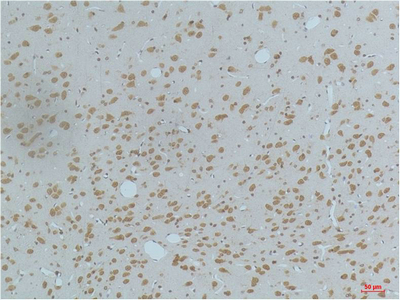
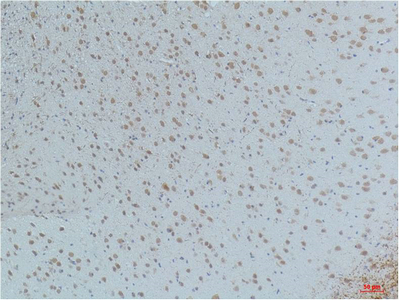
Main InformationTargetCaMKIIβ/γ/δHost SpeciesMouseReactivityHuman, Rat, MouseApplicationsIHC, IFMW50kD (Observed)Conjugate/ModificationPhosphoDetailed InformationRecommended Dilution RatioIHC 1:100-200; IF 1:50-200FormulationLiquid in PBS containing 50% glycerol, 0.5% BSA and 0.02% sodium azide.SpecificityCaMKIIβ/γ/δ (Phospho Thr287) protein detects endogenous levels of CaMKIIβ/γ/δ (Phospho Thr287)PurificationThe antibody was affinity-purified from mouse ascites by affinity-chromatography using specific immunogen.Storage-15°C to -25°C/1 year(Do not lower than -25°C)Concentration1 mg/mlMW(Observed)50kDModificationPhosphoClonalityMonoclonalClone Number4H2Antigen&Target InformationImmunogen:Synthetic Peptide of CaMKIIβ/γ/δ (Phospho Thr287)Specificity:CaMKIIβ/γ/δ (Phospho Thr287) protein detects endogenous levels of CaMKIIβ/γ/δ (Phospho Thr287)Other Name:CAMK2B ; CAM2 ; CAMK2 ; CAMKB ; Calcium/calmodulin-dependent protein kinase type II subunit beta ; CaM kinase II subunit beta ; CaMK-II subunit beta ; CAMK2G ; CAMK ; CAMK-II ; CAMKG ; Calcium/calmodulin-dependent protein kinase type II subunit gamma ;Background:The product of this gene belongs to the serine/threonine protein kinase family and to the Ca(2+)/calmodulin-dependent protein kinase subfamily. Calcium signaling is crucial for several aspects of plasticity at glutamatergic synapses. In mammalian cells, the enzyme is composed of four different chains: alpha, beta, gamma, and delta. The product of this gene is a beta chain. It is possible that distinct isoforms of this chain have different cellular localizations and interact differently with calmodulin. Alternative splicing results in multiple transcript variants. [provided by RefSeq, May 2014],Function:Alternative products:The variable region of the CAMK2B protein is encoded by at least 7 exons (V1 to V7). Alternative splicing within this region gives rise to CAMK2B isoforms,Catalytic activity:ATP + a protein = ADP + a phosphoprotein.,enzyme regulation:Autophosphorylation of CAMK2 plays an important role in the regulation of the kinase activity.,Function:CaM-kinase II (CAMK2) is a prominent kinase in the central nervous system that may function in long-term potentiation and neurotransmitter release. Member of the NMDAR signaling complex in excitatory synapses, it may regulate NMDAR-dependent potentiation of the AMPAR and synaptic plasticity.,similarity:Belongs to the protein kinase superfamily.,similarity:Belongs to the protein kinase superfamily. CAMK Ser/Thr protein kinase family. CaMK subfamily.,similarity:Contains 1 protein kinase domain.,subunit:CAMK2 is composed of four different chains: alpha, beta, gamma, and delta. The different isoforms assemble into homo- or heteromultimeric holoenzymes composed of 8 to 12 subunits. Interacts with SYNGAP1 and CAMK2N2 (By similarity). Interacts with MPDZ.,tissue specificity:Widely expressed. Expressed in adult and fetal brain. Expression is slightly lower in fetal brain.,Cellular Localization:Cytoplasm, cytoskeleton . Cytoplasm, cytoskeleton, microtubule organizing center, centrosome . Sarcoplasmic reticulum membrane ; Peripheral membrane protein ; Cytoplasmic side . Cell junction, synapse . In slow-twitch muscle, evenly distributed between longitudinal SR and junctional SR.Tissue Expression:Widely expressed. Expressed in adult and fetal brain. Expression is slightly lower in fetal brain. Expressed in skeletal muscle.Research Areas:>>ErbB signaling pathway ; >>Calcium signaling pathway ; >>cAMP signaling pathway ; >>HIF-1 signaling pathway ; >>Oocyte meiosis ; >>Necroptosis ; >>Adrenergic signaling in cardiomyocytes ; >>Wnt signaling pathway ; >>Axon guidance ; >>Circadian entrainment ; >>Long-term potentiation ; >>Neurotrophin signaling pathway ; >>Cholinergic synapse ; >>Dopaminergic synapse ; >>Olfactory transduction ; >>Inflammatory mediator regulation of TRP channels ; >>Insulin secretion ; >>GnRH signaling pathway ; >>Melanogenesis ; >>Oxytocin signaling pathway ; >>Glucagon signaling pathway ; >>Aldosterone synthesis and secretion ; >>Cushing syndrome ; >>Gastric acid secretion ; >>Parkinson disease ; >>Pathways of neurodegeneration - multiple diseases ; >>Amphetamine addiction ; >>Tuberculosis ; >>Pathways in cancer ; >>Proteoglycans in cancer ; >>Glioma ; >>Diabetic cardiomyopathy ; >>Lipid and atherosclerosis
商品信息已成功复制,启研竭诚为您服务


